Feature Factories vs. Product Outcomes: Why More Features Don’t Win
Your roadmap may be growing while your product value is shrinking.
That sentence sounds like a contradiction. More features should mean more value. In practice, it’s often the opposite. Teams ship faster than ever. The changelog gets longer every sprint. Yet retention flattens. Support tickets pile up. The product feels harder to use than it did a year ago.
This is the feature factory problem. It’s not a lack of effort. It’s a structural pattern. Success gets measured by what a team ships. Not by what changes for the customer or the business.
This article breaks down what a feature factory actually looks like. It covers what feature bloat costs a growth-stage company. And it covers how outcome-driven product development, paired with the right prioritization framework, pulls a team out of the trap.
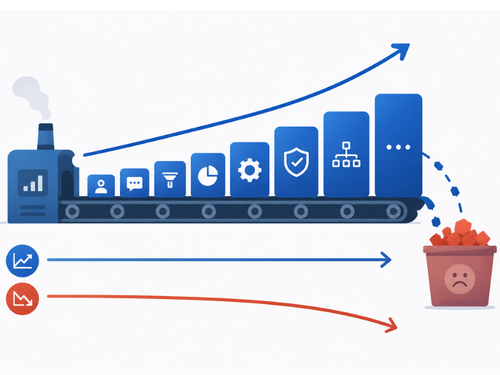
1. What Is a Feature Factory?
Quick answer:
A feature factory is a product team structure where success is measured by shipping velocity. Think number of features released, story points closed, roadmap items delivered. It’s not measured by real change in customer or business outcomes. Teams build what’s requested, ship it, and move on. Nobody checks whether it actually solved anything.
The term didn’t come from nowhere. Product leaders have written for years about the gap between output and outcome. Output is what a team builds. Outcome is what changes because of it. A feature factory optimizes entirely for the first. It rarely measures the second.
A few signs you’re running one:
- Roadmap prioritization is driven by whoever asked loudest. A sales team, a single enterprise account, an executive’s pet idea. Rarely by validated customer problems.
- Success reporting to leadership is a list of shipped items. Not a change in activation, retention, or revenue.
- Nothing gets removed. The feature count only goes up. No one owns the decision to sunset something that isn’t working.
- Discovery is skipped. Requirements arrive as solutions, like “add an export button.” Not as problems, like “customers can’t get their data into their reporting tools.”
- Adoption isn’t tracked. Nobody can tell you, with data, whether last quarter’s biggest release is actually used.
None of this is a failure of individual product managers or engineers. It’s usually a failure of what the organization chooses to measure. And what it chooses to reward.
2. The Real Cost of Feature Bloat
Quick answer:
Feature bloat is expensive in ways that don’t show up on a single line item. Unused features still cost engineering time to maintain. They still expand the support and QA surface. They still add friction to onboarding, even when almost nobody uses them.
The scale of the problem is bigger than most teams assume. Pendo’s Feature Adoption Report analyzed usage data across 615 subscriptions. It found that only about 12% of features drive 80% of daily usage. Most shipped functionality sees little to no regular use. That echoes an older, widely cited Standish Group finding: a large share of enterprise software features are rarely or never touched.
None of this is a failure of individual product managers or engineers. It’s usually a failure of what the organization chooses to measure. And what it chooses to reward.
For a growth-stage company, that translates into concrete costs:
- Engineering drag. Every feature is code that has to be maintained and tested. It has to stay compatible with every future release, whether five customers use it or five thousand.
- Onboarding friction. New users face a wall of options built for edge cases they’ll never hit. The core workflow gets buried underneath.
- Support and QA load. More surface area means more edge cases to test. It means more tickets when something breaks, regardless of usage volume.
- Diluted differentiation. A product trying to be everything to everyone usually loses the sharp value proposition that won its early customers.
- Slower velocity over time. Every dependency added today constrains tomorrow’s roadmap. Feature bloat compounds. It’s rarely one big decision. It’s a hundred small ones nobody revisited.
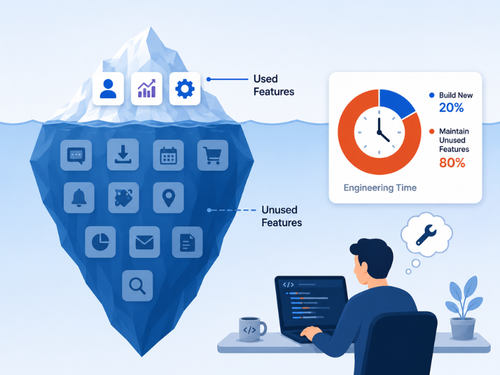
None of this shows up as a single, obvious mistake. It shows up eighteen months later. By then, the team ships slower than it did a year ago, defending a surface area it never meant to build.
3. Why Feature Factories Keep Winning Internally
If feature factories are so costly, why do they persist? Because the incentives inside most organizations reward exactly this behavior.
- Roadmaps get treated as commitments to stakeholders, not as hypotheses to test. So “we’re removing this” reads as a broken promise.
- Sales and customer success teams sit close to revenue and are loud about specific requests. The cost of an unused feature is diffuse and invisible on any single dashboard.
- Shipping is easy to report upward. “We shipped 12 features this quarter” is a simple story. “We moved activation from 34% to 41%” takes instrumentation and patience. And the willingness to admit a quarter didn’t move the number.
- Career incentives for product managers often still reward visible output. Not the harder, slower work of proving impact.
This is an organizational design problem before it’s a product management problem. Fixing it starts with changing what gets measured. And what gets rewarded. Hiring more disciplined product managers and hoping the culture follows rarely works on its own.
4. What Outcome-Driven Product Development Looks Like
Quick answer:
Outcome-driven product development ties every roadmap item to a measurable change in customer behavior or business results. Think activation, retention, expansion revenue, time-to-value. Not a count of features shipped. Teams run discovery before delivery. A feature isn’t “done” until its outcome is validated.
The practical shift looks like this:
| Feature factory | Outcome-driven team |
|---|---|
| Success = features shipped | Success = measurable change in a target metric |
| Roadmap items come from requests | Roadmap items come from validated problems |
| Discovery happens after the build starts, if at all | Discovery happens before commitment to a solution |
| Nothing is ever removed | Features are sunset when data shows low value |
| Leadership sees a changelog | Leadership sees a metric moving (or not, with a clear next step) |
The hardest part isn’t defining outcome metrics. It’s the discipline to hold a release accountable to them after launch. Sometimes the answer is: this didn’t move the number, so we’re rolling it back or trying something else. A feature factory never asks that second question.
5. Prioritization Frameworks for Growth-Stage Products
Quick answer:
Prioritization frameworks like RICE, ICE, and Now-Next-Later help growth-stage teams rank competing roadmap items with shared criteria instead of politics. None of them fix a feature factory on their own. They only work when fed honest outcome data. And they can be gamed just as easily as any other scoring system.
Prioritization frameworks earn their keep in growth-stage products. Request volume from customers, sales, and internal stakeholders usually outpaces engineering capacity by a wide margin. A product prioritization framework is what most teams reach for first. Frameworks genuinely help, with one caveat worth stating plainly.
RICE (Reach, Impact, Confidence, Effort)
Scores each item on reach, impact, confidence, and effort. It’s useful for comparing dissimilar initiatives on common terms. But every input is still an estimate. Someone can inflate it to favor a pet project.
ICE (Impact, Confidence, Ease)
A lighter version of RICE, better suited to fast-moving teams. It works as a quick gut-check rather than a rigorous model. The tradeoff is precision. ICE scores are easy to produce and just as easy to argue with.
Now-Next-Later
A time-horizon framework rather than a scoring model. It communicates roadmap intent to stakeholders without over-committing to dates. It also makes room for discovery work in the “Later” column, instead of forcing everything into a delivery date.
Opportunity Solution Trees
Popularized in continuous discovery practice. This maps a business outcome down through customer opportunities to candidate solutions. It’s the closest fit for outcome-driven teams, because the outcome sits at the top of the tree, not the feature.
The honest takeaway: no framework replaces the willingness to say no to a loud stakeholder. No scoring model is more rigorous than the honesty of the inputs typed into it. Pick one. Use it consistently. Treat the score as a starting point for a conversation, not the final word.
6. How to Move From Feature Factory to Outcome Team
This shift rarely happens through a single mandate. It happens through a handful of concrete, repeatable changes:
- Audit the last two quarters of releases against usage data. Which shipped items moved a real metric? Which ones has nobody checked?
- Attach an outcome to every roadmap item before it’s approved, not after it ships. If a metric can’t be named, the item isn’t ready for the roadmap yet.
- Change what leadership sees in reviews. Replace “here’s what we shipped” with “here’s what moved, and here’s what we’re doing about what didn’t.”
- Build a removal habit. Sunsetting a low-adoption feature should be routine. Not an exceptional, politically risky decision.
- Protect discovery time. Teams that skip validation because delivery feels faster end up rebuilding the same feature twice. Once wrong, once right.

None of this requires abandoning delivery speed. It requires redirecting that speed toward validated problems instead of the loudest request in the queue. Done consistently, that’s exactly what separates products that compound value from products that just accumulate features.
For teams that got the early architecture decisions right but are now weighing which capabilities deserve engineering time next, it’s worth revisiting how those choices interact with growth. See our pillar piece on why products fail at scale for the architecture side of this same problem.
A feature factory rarely announces itself. It looks, from the inside, like a busy, productive team. The real signal isn’t a lack of output. It’s a growing roadmap next to a flat retention curve. Outcome-driven product development, paired with a prioritization framework the team actually holds itself to, is how that gap closes.
If you’re weighing how to restructure a product team’s roadmap process, or want a technical partner who builds with outcomes in mind, explore our case studies or contact the IMT team to talk through your product’s roadmap.
Frequently Asked Questions
What is a feature factory in product management?
A feature factory is a product team that measures success by shipping velocity. That means features released or story points closed. It’s not measured by outcomes like activation, retention, or revenue. Teams build what’s requested without checking whether it solves a real problem.
What’s the difference between output and outcome in product development?
Output is what a team builds: features, releases, story points. Outcome is what changes for the customer or the business because of that work. Think faster onboarding, higher retention, more expansion revenue. A feature factory optimizes for output. An outcome-driven team optimizes for outcome, and treats output as the means, not the goal.
Which prioritization framework works best for growth-stage SaaS?
There’s no single best framework. RICE and ICE work well for scoring competing initiatives. Now-Next-Later works well for communicating roadmap intent without over-committing. Opportunity Solution Trees work well for teams practicing continuous discovery. The framework matters less than the discipline to feed it honest data, and to revisit scores as new evidence arrives.
How do I know if my product has feature bloat?
Pull usage data on every feature shipped in the last year. Check adoption against the core workflow. Watch for three signs: a large share of features with little to no regular use, onboarding that takes longer than it used to, or no feature ever removed. Any one of these means feature bloat is likely already a problem worth addressing.