MVP Architecture vs. Scalable Systems: When Should You Invest in Scale?
The best MVP is usually underbuilt – until it isn’t.
That’s not a flaw. It’s the point. Every founder who ships fast is making a bet. Speed matters more than durability – until it doesn’t.
Get the timing wrong in either direction, and the bill comes due. Overbuild too early, and the launch slips while competitors ship. Underbuild too long, and growth stalls under a rebuild nobody budgeted for.
This is the real question behind MVP architecture. Not whether to invest in scale, but when. Founders, product managers, and CTOs who get this right treat MVP architecture differently. It’s a sequence of decisions, not a single choice made on day one.
1. What is “MVP Architecture”
Quick answer:
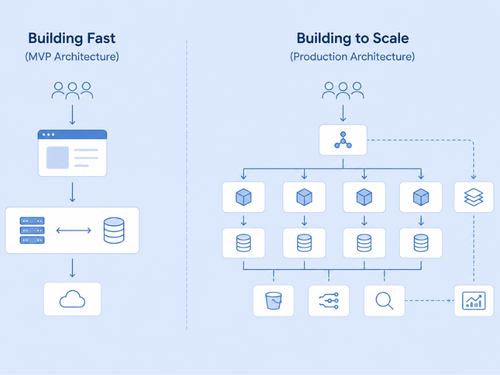
MVP architecture is a set of deliberate shortcuts. Teams use it to test a product idea fast, before investing in systems built for scale. It’s a strategy, not a lack of discipline.
A single codebase. One database. Manual deployments. None of these are mistakes in an MVP. They’re usually the correct call. A team that spends months on fault-tolerant infrastructure before its first paying customer has usually built the wrong thing. Just a very durable version of it.
Good MVP architecture is deliberate about which shortcuts it takes, and honest about which ones it will need to revisit. That second part is where most teams fall short. They ship fast, then forget the shortcut was ever a decision at all.
| MVP priorities | Scale priorities |
|---|---|
| Fastest path to a working product | Fastest path to reliable growth |
| Single codebase, single database | Separated services where growth demands it |
| Manual processes are fine | Manual processes become the bottleneck |
| Founders make most technical calls | Decisions need to scale beyond the founders |
| Speed of learning matters most | Predictability under load matters most |
Neither column is wrong. The failure mode is staying in the MVP column after growth has already arrived. Or jumping to the scale column too soon.
2. Signs You’re Overbuilding Your MVP Architecture
Quick answer:
Overbuilding shows up as infrastructure investment with no user or revenue signal behind it yet. It usually feels like progress. It’s actually deferred risk with no proven upside.
- Multi-region infrastructure before your first paying customer. Redundancy only pays off once downtime has a real cost attached to it.
- Microservices for a two- or three-person engineering team. Splitting a system that one team can hold in their head just adds coordination overhead.
- A granular permissions system for ten users. Role-based access control matters once customers demand it, not before.
- Custom infrastructure instead of managed services. Building your own queueing layer or auth system before product-market fit is a bet on a problem you don’t have.
- Tuning queries for data volume you don’t have. Premature performance work burns time that validation needs more.
None of these are wrong choices in isolation. Together, they describe a team optimizing for a scale it hasn’t earned. Meanwhile the question that actually determines survival – whether anyone wants the product – sits unanswered.
3. Signals It’s Time to Move Beyond MVP Architecture
Quick answer:
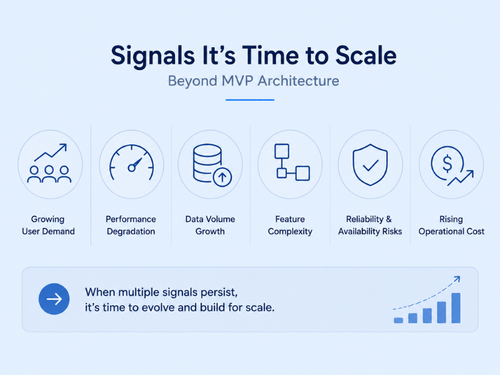
The signals that MVP architecture has run its course are operational, not aspirational. Feature velocity drops. The same incidents repeat. Enterprise prospects start asking questions your team can’t answer.
- Feature releases take longer than they used to, with no new complexity to explain it.
- On-call engineers keep firefighting the same class of incident. That’s a structural gap, not bad luck.
- A single database is timing out under concurrent writes that were perfectly fine six months ago.
- New engineers take weeks to onboard, because nothing about the system is documented or decoupled.
- Enterprise prospects, especially in the EU and Switzerland, start asking harder questions. Data residency, audit trails, uptime guarantees – things your current setup can’t confidently answer.
Any one of these on its own isn’t a crisis. Two or three together mean the MVP architecture that got you here won’t get you to the next stage.
4. A Staged Roadmap From MVP to Enterprise Architecture
Quick answer:
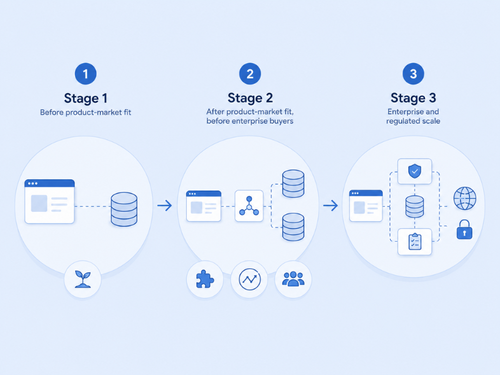
MVP architecture isn’t replaced all at once. It evolves in stages, tied to where the product actually is. Not to a roadmap slide, and not to a competitor’s tech stack.
Stage 1: Before product-market fit
Keep the MVP architecture lean. One codebase, one database, manual processes. The main risk here is building resilience for a product that might not survive contact with the market.
Stage 2: After product-market fit, before enterprise buyers
This is where most teams need to act. Decouple the two or three components under the most growth pressure. Add basic observability. Revisit any assumption built for one customer at a time. None of this requires a rewrite – it requires triage.
Stage 3: Enterprise and regulated scale
Compliance, audit trails, and data residency stop being optional. We see this constantly with clients selling into EU and Swiss enterprise buyers. A technical review is now standard procurement, not an afterthought.
For more on what comes next, see our Product Scalability guide (add live URL once published).
5. The Real Cost of Getting the Timing Wrong
Quick answer:
Premature scaling is one of the most common – and least visible – causes of startup failure. It looks like progress until it doesn’t.
Research from the Startup Genome Project tracked thousands of high-growth startups. Most failures among fast-growing companies traced back to scaling before the model was validated. Companies that scaled prematurely were far less likely to ever reach meaningful monthly revenue. Companies that timed their scaling correctly grew substantially faster in the years after.
Technical debt compounds quietly. The first few months of an MVP feel fine. Then velocity drops as engineers route around old decisions instead of shipping new ones. By the time leadership notices the slowdown, the underlying cause is usually a year old.
The visible cost is a rebuild – weeks spent rewriting something that used to work. The invisible cost is worse. Features that never shipped. A deal that stalled during a security review. An engineer who left because every sprint felt like triage.
6. Questions to Ask Before You Move Past MVP Architecture
Quick answer:
Before investing in scale, leadership should be able to answer a short set of concrete questions. If more than one answer is “we’re not sure,” that’s the signal to review the architecture now.
- Are we scaling because customers are pulling us there, or because it feels safer than selling more? Growth investment should follow demand, not anxiety.
- What’s the smallest change that removes our current bottleneck? Most scaling problems have a narrow fix, not a full rewrite.
- Which of our MVP shortcuts are reversible, and which require a rebuild? Not every shortcut costs the same to unwind.
- Could we pass a technical review from an EU or Swiss enterprise buyer today? That question increasingly decides whether a deal closes.
7. How IMT Solutions Supports MVP Architecture Decisions
IMT Solutions has spent 17 years helping founders and enterprise engineering teams make better architecture decisions. Decisions that hold up under growth, not just at launch. We’re ISO 27001 certified, and our clients span BFSI, healthcare, and enterprise software across the EU, Switzerland, and the US.
Our approach starts with an honest audit. What’s fine to leave alone, what needs attention now, and what can safely wait. Then we prioritize the fixes that matter over the fixes that are merely convenient.
If you’re deciding whether your MVP architecture is ready for its next growth stage, explore our case studies. Or contact our team to talk through where your system stands. You can also browse the IMT Solutions blog for more on scalable software architecture and engineering delivery.
Frequently Asked Questions
What is MVP architecture?
MVP architecture is the technical setup a team uses to test a product idea with real users, fast. Typically that means a single codebase, one database, and manual processes. It’s designed for speed, not durability – usually the correct trade-off before product-market fit.
When should a startup move from MVP architecture to scalable architecture?
Not at launch, and not never. The right time is after product-market fit, once growth is real and repeatable. Investing in scalable software architecture before that point usually means building for a version of the product that never ships.
What’s the difference between MVP architecture and premature scaling?
MVP architecture is a deliberate, temporary set of shortcuts. Premature scaling is investing in infrastructure, headcount, or features before validating that the model works. One is a strategy. The other is one of the most common causes of startup failure.
Do EU and Swiss enterprise buyers expect scalable architecture before signing?
Increasingly, yes. Enterprise buyers in the EU and Switzerland often require evidence of data residency, audit trails, and uptime guarantees. They typically ask for this before signing. Building these into system design at Stage 2 is far cheaper than retrofitting them later. Waiting means fixing it after a deal is already on the table.
How do I know if my MVP architecture needs a scalability review now?
Three signs are worth acting on. Feature releases take longer than they used to. The same class of incident keeps repeating. Enterprise prospects are asking security or compliance questions your team can’t confidently answer. Any one of these is reason enough to review the architecture before the next growth push.