AI Engineering Playbooks: Turning AI Governance Into Repeatable Practice
A governance policy says what should happen. A playbook is what actually happens when an AI agent pushes code at 2 a.m., a model output looks wrong, or a new hire joins mid-sprint and nobody has time to walk them through the rules.
Most engineering organisations have the policy. Few have the playbook. That gap is where AI engineering playbooks earn their place – not another compliance document, but the operational layer that turns human oversight principles into procedures any engineer can follow without asking who is in charge.
Without playbooks, AI adoption stays experimental. Every team interprets governance differently. Every escalation gets improvised. Every new engineer learns oversight by trial and error, usually right after something has already gone wrong.
This article is for engineering ops teams, platform leads, and VPs of Engineering who already understand why human oversight matters – we covered the why in our pillar article on human oversight – and are now solving the harder operational problem: how do you make oversight repeatable across dozens of engineers, multiple teams, and, for organisations in Switzerland, the broader EU, and the US, an auditor who eventually wants proof it happened.
Why Governance Policies Fail Without Playbooks
Quick answer:
A governance policy describes intent – what AI oversight should look like. A playbook describes execution – who does what, in what order, with what authority. Organisations that stop at policy end up with inconsistent practice: one team enforces the review gate strictly, another skips it under deadline pressure, and nobody can explain the difference when an auditor asks.
Policy documents are written once and read rarely. They sit in a shared drive, get referenced in onboarding decks, and quietly diverge from what teams actually do once a deadline gets tight.
The divergence is rarely malicious. It is structural. A policy that says “security-sensitive code requires human review” does not specify who reviews it, how fast, or what happens when the usual reviewer is on leave. Each team fills the gap with its own judgment – and a year later, five teams are running five quiet variations of the same rule.
A playbook closes that gap. It turns the policy statement into a procedure: named roles, defined steps, an explicit fallback when the usual reviewer is not available. The policy stays stable. The playbook is what actually gets followed.
What Is an AI Engineering Playbook?
Quick answer:
An AI engineering playbook is a living, versioned set of procedures that translates governance principles – internal policy, EU AI Act requirements, FINMA or DORA expectations – into step-by-step actions for engineers. It answers three questions for any AI-related decision: who acts, in what sequence, and with what authority to approve, modify, or stop.
Not every team calls it a playbook. Some call it a runbook, some call it an operating manual – the function is the same: a reference any engineer can open mid-incident or mid-review and know exactly what to do next, without escalating a question that should already have an answer.
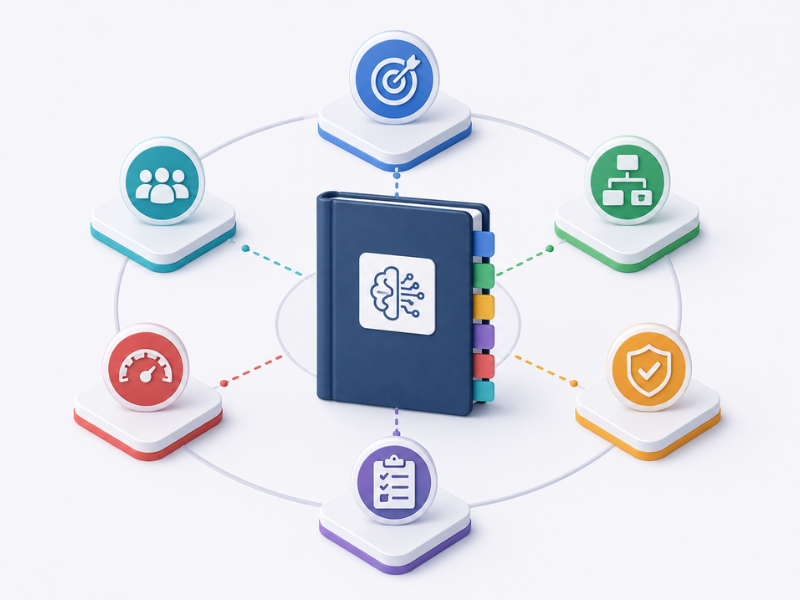
A useful playbook usually covers four categories.
- Review playbooks. Define how AI-generated code moves through review – which tier applies, who signs off, what evidence is required before merge.
- Incident playbooks. Define what happens when an AI agent or model behaves unexpectedly in production – who is paged, what gets rolled back, who decides when it is safe to resume.
- Onboarding playbooks. Define how a new engineer learns the team’s oversight expectations before they touch AI-assisted workflows unsupervised.
- Audit playbooks. Define how the organisation reconstructs a decision trail when a regulator, client, or internal audit asks who approved this, and on what basis.
Each of these connects back to the same governance principles covered in our pillar piece. The playbook is just the part that makes them executable.
Documentation Templates: Capturing Decisions, Not Just Code
Quick answer:
Documentation templates standardise what gets recorded every time an AI-assisted decision is made – not just the code, but the reasoning, the reviewer, and the approval. Without a standard template, every team documents differently, which means almost nothing is comparable and almost nothing is auditable.
Most engineering teams already document code changes. Far fewer document the AI governance decision sitting underneath the code change: why this PR needed elevated review, who approved it, and what they checked.
A standard template fixes that. It does not need to be heavy – a short, structured block attached to the existing PR template is usually enough.
| Documentation Artifact | What It Captures | Typical Owner |
|---|---|---|
| AI usage disclosure tag | Whether AI generated, assisted, or had no role in the change | Engineer |
| Architecture decision record (ADR) | The reasoning behind structural choices AI proposed or implemented | Tech lead or architect |
| Review sign-off log | Who reviewed, what tier applied, what was checked | Reviewing engineer |
| Escalation record | What triggered escalation, who was notified, how it resolved | On-call lead or incident owner |
The goal is not paperwork for its own sake. It is making the answer to “why did we approve this” retrievable in thirty seconds instead of a half-day reconstruction project. For organisations building toward EU AI Act or DORA compliance, this AI governance documentation is also exactly what auditors ask to see first – not the policy, the record. We cover the underlying audit data requirements in our article on AI data infrastructure and compliance.
Escalation Procedures: What Happens When AI Behaviour Falls Outside Expected Ranges
Quick answer:
Escalation procedures define, in advance, what counts as an AI failure significant enough to interrupt normal workflow, who gets notified, and how fast. Teams that improvise escalation during an incident lose time deciding who is responsible instead of fixing the problem.
Our pillar article on human oversight makes the point that escalation paths need to be defined before an incident, not during one. A playbook is where that principle becomes a procedure – severity tiers, named approvers, and response windows that do not depend on who happens to be online.
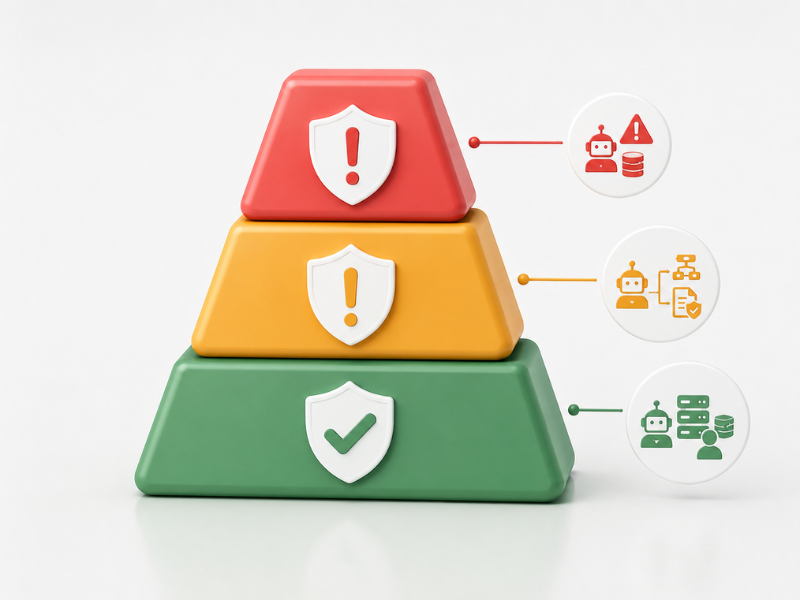
| Tier | Trigger | Required Response |
|---|---|---|
| Tier 1 – Minor | AI output flagged by automated checks but contained pre-merge | Reviewer resolves within the standard review cycle, no escalation needed |
| Tier 2 – Significant | AI agent action affects shared environments, or AI output reaches a compliance-sensitive workflow | On-call lead notified within 30 minutes, sign-off required before resuming |
| Tier 3 – Critical | AI agent action affects production, customer data, or a regulated system | Engineering director and compliance contact notified within 15 minutes, rollback authority pre-assigned |
The tiers do not need to be elaborate. They need to be specific enough that two different engineers, faced with the same situation at 3 a.m., make the same call. That consistency is the entire point of writing it down in advance.
Engineering Onboarding: Making Oversight Muscle Memory
Quick answer:
Engineering onboarding for AI-augmented teams should treat oversight skills the same way it treats codebase familiarity – something a new hire is taught, checked, and signed off on, not something they pick up by observation over several months.
New engineers usually get a fast walkthrough of the codebase and a slower, informal exposure to how the team actually handles AI-assisted work. That second part matters more than most onboarding plans treat it.
A structured onboarding playbook closes the gap with a few concrete steps.
- Shadow period. New engineers observe live reviews and escalations for a defined window before approving anything independently.
- Competency check before sign-off authority. A new reviewer does not get merge authority on security-sensitive AI-generated code until they have demonstrated they can apply the review tiers correctly.
- Refresher cadence. Oversight rules change as tooling and regulation evolve; a playbook without a scheduled review date is already out of date.
- Cross-team rotation. Engineers who only ever see their own team’s interpretation of the rules do not notice when interpretations have quietly diverged.
This is also where the EU AI Act’s human oversight requirement becomes concrete at the individual level: a regulator does not just want a policy that says humans review AI decisions. They want evidence that the humans doing the reviewing were qualified to do it.
Beyond the Three Pillars: What Else Belongs in the Playbook
Quick answer:
Documentation, escalation, and onboarding are the foundation – but a complete AI engineering playbook also needs clear ownership, a review cadence for the playbook itself, and integration with the tools engineers already use. A playbook nobody maintains becomes exactly as unreliable as the policy it replaced.
Most organisations that get this far stop at documentation, escalation, and onboarding. Those three are necessary. They are not sufficient.
- Ownership and RACI. Every playbook section needs a named owner accountable for keeping it current – not “the platform team,” a specific role.
- Version control on the playbook itself. Treat playbook changes like code changes: versioned, reviewed, and dated, so a six-month-old incident can be checked against the rules that applied at the time.
- Tooling integration. A playbook that lives only in a wiki gets ignored under deadline pressure. The most effective versions surface the relevant step directly inside the PR template, the CI pipeline, or the incident management tool.
- Cross-team consistency audits. Periodically check whether different teams are actually applying the same playbook the same way – divergence is the default outcome of organisational growth, not an exception.
The Regulatory Case for Playbooks
For engineering organisations operating in regulated markets, playbooks are not just an internal efficiency exercise.
The EU AI Act’s human oversight requirement for high-risk systems is not satisfied by a policy statement. Regulators expect evidence of process – who reviewed what, when, and on what authority. A playbook is the artifact that produces that evidence as a byproduct of normal work, instead of as a special exercise before an audit.
DORA adds a similar expectation for financial institutions across Germany, France, the Netherlands, and the rest of the EU: AI systems need to be tested, documented, and recoverable – which in practice means the incident playbook and rollback procedure need to already exist before an examiner asks for them.
For Swiss financial institutions and their EU-facing counterparts, FINMA’s governance guidance tracks closely with EU expectations. The organisations that handle this well treat the playbook as the compliance artifact – not a separate compliance project running alongside engineering.
Building Your First AI Engineering Playbook
Quick answer:
Start with the highest-risk workflow already in production, not a comprehensive playbook covering everything at once. A complete playbook for one critical workflow beats a partial playbook for ten.
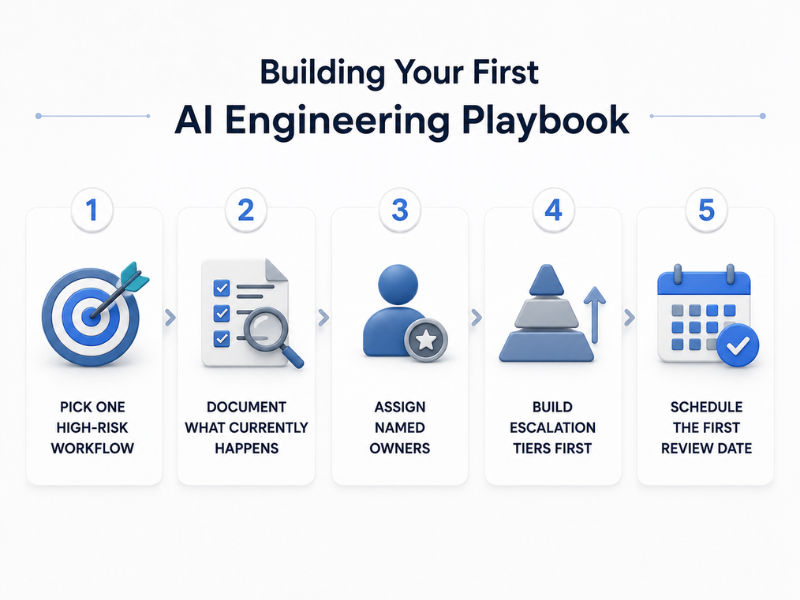
- Pick one high-risk workflow first. Security-sensitive code review, or production deployment approval – whichever already keeps your engineering director up at night.
- Write down what currently happens, not what should happen. Most teams discover their actual practice diverges from policy before they can design the procedure that replaces it.
- Assign named owners, not teams. “The DevOps team” is not accountable. A named role with a backup is.
- Build the escalation tiers before the documentation templates. Escalation procedures expose the gaps fastest; documentation can follow once the decision points are clear.
- Schedule the first review date before you publish. A playbook with no review date is a policy document with extra formatting.
How IMT Solutions Supports AI Engineering Governance
IMT Solutions works with engineering organisations in financial services, healthcare, and enterprise software to build the operational layer underneath AI governance policy – the playbooks, documentation templates, and escalation procedures that make human oversight something a team actually does, not something a policy document claims.
If you are translating governance principles into procedures your engineers can follow without escalating every judgment call, explore our case studies or contact our team to talk through your environment.
Frequently Asked Questions
What is an AI engineering playbook?
An AI engineering playbook is a living, versioned set of procedures that converts AI governance policy into specific actions – who reviews what, who gets notified when something goes wrong, and how new engineers are brought up to the team’s oversight standard. It exists to make governance consistent across teams and demonstrable to regulators.
How is a playbook different from a governance policy?
A policy states intent: what oversight should exist. A playbook states execution: who does it, in what order, with what authority, and what gets recorded along the way. Policies change rarely; playbooks should be reviewed and updated as tooling, team structure, and regulation evolve.
What should an AI engineering playbook include first?
Start with the escalation procedure for the organisation’s highest-risk AI workflow – usually security-sensitive code review or production deployment approval. Escalation tiers expose gaps in oversight faster than documentation templates do, and they are the part teams improvise most dangerously without a written procedure.
Do AI engineering playbooks help with EU AI Act or DORA compliance?
Yes. Both frameworks expect organisations to demonstrate human oversight as a functioning process, not just a documented intention. A playbook produces the audit trail – who reviewed, who approved, who escalated – as a natural byproduct of how engineers work, rather than as a separate compliance exercise built after the fact.
How often should an AI engineering playbook be updated?
At minimum, on a fixed review cadence – quarterly is common for fast-moving AI tooling – and immediately after any incident that exposes a gap in the existing procedure. A playbook without a scheduled review date tends to drift out of sync with both the tools in use and the regulatory requirements around them.