The Hidden Cost of AI Technical Debt
Why does every change break something unexpected? Why is shipping new features slower now than before the AI tools arrived? Why is the codebase getting harder to maintain, not easier?
This article is a guide for CTOs, VPs of Engineering, and technical leaders who need to understand why AI technical debt forms, why it is harder to detect than traditional debt, and what a credible strategy for managing it.
AI Technical Debt
Quick answer:
AI technical debt is the accumulation of future maintenance, debugging, and refactoring costs caused by prioritizing the speed of AI implementation over long-term software sustainability. It stems from rapid AI adoption and the use of generative coding tools.
AI technical debt is a specific and underappreciated consequence of using AI coding tools at scale without redesigning the engineering process around them. It is not the same as the technical debt your teams have always managed. It forms faster, compounds invisibly, and surfaces at the worst possible moment – usually when you are under the most pressure to move quickly.
Why AI Code Speed Creates a New Kind of Risk
AI is not merely a faster developer. It is a “fundamentally different kind of contributor” – one that optimises for immediate correctness rather than long-term maintainability.
A human developer taking a shortcut knows they are taking a shortcut. An AI model generating code has no such awareness. It produces what passes the test. What it does not produce is an understanding of why it made each decision, whether that decision fits the surrounding architecture, or what will happen to the next developer who has to work with that code.
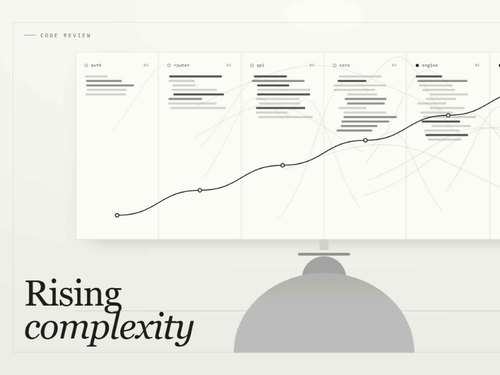
Traditional technical debt is managed through security patches and conscious trade-offs. AI technical debt is different in that it accumulates at machine speed, without the developer’s awareness of the shortcut being made. That difference in visibility is what makes it dangerous at scale.
A 2024 Stanford study found that developers using AI coding assistants were more likely to introduce security vulnerabilities than those working without them – not because AI introduced bugs deliberately, but because generation speed reduced the attention applied to review. The model produced code. The review process was not built for the volume it created.
The Productivity Illusion
Most organisations measure AI’s impact on engineering through the wrong metrics. Lines of code generated, individual task completion time, sprint velocity – these measure output, not outcomes.
Quick answer:
The hidden cost of AI technical debt only surfaces in metrics most teams are not tracking: time to understand an unfamiliar module, cost of onboarding a new developer, mean time to isolate a production bug. These are the numbers that reveal whether AI is improving delivery or accelerating debt accumulation.
The Three Hidden Cost Categories
AI technical debt does not surface as a single failure mode. It accumulates across three distinct categories, each with its own downstream consequences.
1. Poor Architecture Patterns
AI code generation tools are trained to produce code that works. They are not trained to produce code that fits your specific system architecture, respects your existing design patterns, or reflects decisions made eighteen months ago by engineers who are no longer on the team.
The result is inconsistency at scale. AI might generate a clean, correct function – but use a pattern that contradicts how the rest of the module is structured. Multiply that across hundreds of PRs over six months, and the codebase begins to fragment.
For organisations in regulated sectors – BFSI, healthcare and enterprise software serving EU clients – this architectural drift is not just a maintenance concern. It creates auditability gaps that can become compliance liabilities under the EU AI Act and DORA frameworks. We cover those infrastructure requirements in detail in our article on AI Data Infrastructure and Compliance.
2. Documentation Gaps
AI writes code faster than humans can document it. In practice, documentation does not happen at all.
This is not a new problem. Documentation has always been the step that gets skipped when deadlines compress. What AI does is make code generation so fast that the gap between “written” and “understood” becomes enormous.
For AI systems specifically – machine learning pipelines, inference endpoints, data transformation logic – this opacity has a regulatory dimension. Under the EU AI Act, high-risk AI systems require technical documentation maintained throughout the system lifecycle. Documentation that was never written cannot be retroactively assembled from AI-generated code. The compliance gap created in development does not close itself at deployment.
3. Maintenance Burden
This is the category that shows up most visibly on engineering budgets – and the one most organisations do not connect back to their AI tool adoption.
AI-generated code accumulates a specific type of maintenance burden: code that no one fully understands but that cannot be easily replaced because it is too deeply integrated. Every developer who has worked on a legacy codebase knows this pattern.
The difference with AI technical debt is the speed at which it forms. What took years to accumulate in a manually-built system can emerge in months when AI is generating code at scale without proportional increases in review, documentation, and ownership assignment.
Developer time spent reverse AI-generated code that was never properly reviewed is not a future risk. It is a current operational expense that does not show up in the AI tool subscription budget.
The Compounding Effect
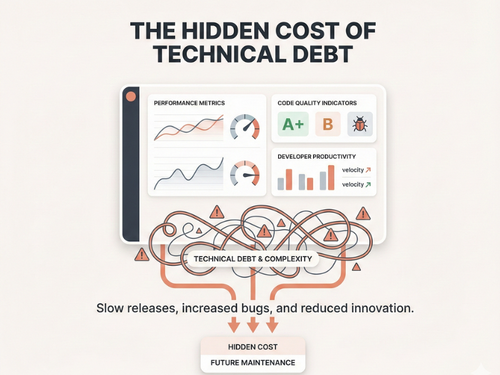
Technical debt compounds. That is its defining characteristic. A documentation gap today makes tomorrow’s feature slower to develop. A poor architectural decision today makes next year’s migration more expensive.
AI technical debt compounds at the same rate – but it accrues faster, because the generation speed that creates the productivity gain also accelerates the accumulation.
Quick answer:
Organisations facing this problem are not the ones that adopted AI carelessly. Many adopted it thoughtfully, with policy frameworks and approved tooling. What they missed was the systems-level change required to prevent debt from accumulating at AI velocity. The tools changed. The engineering process did not.
As we covered in our piece on Why Enterprise AI Fails in Production, the root cause is everything around the model. AI technical debt is that same pattern applied to the development lifecycle itself.
What the EU AI Act and DORA Mean for Engineering Teams
European regulators have moved beyond general IT governance and are now placing AI-specific obligations on how systems are built, documented, and maintained. For engineering leaders in Switzerland – and across EU member states – two frameworks are directly relevant to the AI technical debt problem.
The EU AI Act requires high-risk AI systems to maintain technical documentation throughout the system lifecycle. It also requires automatic logging of every decision, data input, and model version in production. AI-generated code that was never reviewed at an architectural level, never documented, and never assigned clear ownership cannot satisfy these requirements.
DORA (Digital Operational Resilience Act) requires institutions to test and document the resilience of all ICT systems, including AI. For financial organisations across Europe, poorly maintained AI-generated codebases that cannot be traced, audited, or recovered from incident are now a legal liability – not just an engineering inconvenience.
Switzerland is not an EU member, but Swiss enterprises serving EU markets are effectively within scope for their EU-facing AI deployments. FINMA has already begun requesting AI governance disclosures aligned with EU standards. For Swiss banks, insurers, and software firms supplying EU clients, the EU AI Act’s documentation and auditability requirements are operationally in force today.
Defense Strategies for Engineering Teams
Managing AI technical debt requires a combination of governance frameworks, updated review processes, and ongoing architectural oversight. The following principles apply regardless of your industry or the specific AI tools your teams are using.
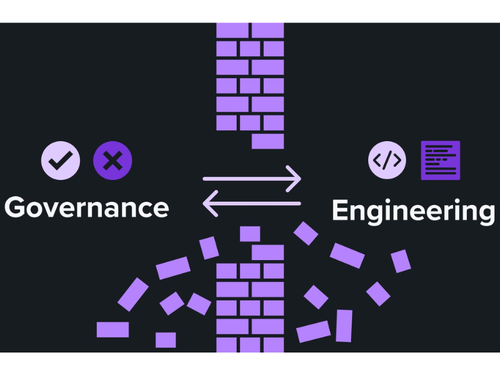
Define Ownership Boundaries Before Expanding AI Access
Not everything AI generates requires the same level of review.
Security-critical modules, authentication logic, and compliance-sensitive workflows have mandatory human review. Boilerplate and scaffolding do not. The distinction must be explicit – written into engineering standards, not assumed from culture.
Redesign Code Review for AI-Generated Volume
A review process built for ten PRs per developer per week does not work at forty. AI-assisted pre-screening for quality and security, combined with human review focused on architecture and business logic, is the pattern that works at scale.
The reviewers approving AI-generated PRs do not fully understand because volume is too high is exactly how AI technical debt becomes invisible until it causes a production failure.
Documentation generated from code context at the point of creation is the only durable solution at scale. Documentation that must be written manually after the fact will not be written consistently – and under EU AI Act obligations for high-risk systems, inconsistent documentation is not documentation.
AI-assisted documentation tooling, built into the CI/CD pipeline, closes this gap without requiring individual developers to change their behaviour.
Measure the Right Outcomes
End-to-end cycle time, defect escape rate, mean time to recovery, and time to understand an unfamiliar module – these are the metrics that reveal whether AI is improving delivery or accelerating debt accumulation. Deployment speed and lines of code are not. Teams that track DORA metrics from the point of AI tool adoption can detect AI technical debt forming before it becomes a crisis. Teams that do not are discovering it in incident postmortems.
What Leaders Should Be Doing Right Now
For CTOs and VPs of Engineering, the practical question is where to start. Here is a prioritised set of actions.
- Audit your current AI-assisted codebase for modules that were AI-generated but have not received architectural-level review. The number is almost always higher than leadership expects – and higher than IT has approved in the tool inventory.
- Define what AI can generate autonomously versus what requires human review before merge. Make this explicit in engineering standards. Security-critical paths, authentication logic, and compliance-sensitive workflows are not candidates for autonomous AI generation.
- Establish documentation gates in your CI/CD pipeline. Code that ships without documentation should require an explicit override – not a silent omission. If documentation is optional, it will not happen.
- Track DORA metrics from the point of AI tool adoption. Deployment frequency, lead time, change failure rate, and mean time to recovery tell you whether AI is improving delivery. Without them, you cannot attribute change to the AI investment – or detect the debt it is creating.
- Classify your AI systems against EU AI Act risk tiers. For high-risk AI in financial services, healthcare, or HR, poorly documented and architecturally fragile AI-generated code is not just a maintenance risk. It is a compliance liability.
We do not believe in one-size-fits-all. A Swiss fintech managing payment AI systems has different obligations than a German healthcare platform building diagnostic models – and our approach reflects that.
If you are trying to understand where your current engineering organisation stands from an AI technical debt and compliance perspective, the best starting point is a conversation.
How IMT Solutions Helps Organisations Manage AI Technical Debt
AI technical debt is not a technology problem. It is a measurement, governance, and process problem – and it is one that compounds the longer it goes unaddressed.
The organisations that pull ahead in software delivery over the next three years will not be the ones with the most AI subscriptions. They will be the ones that took the systems question seriously: not just how to make developers faster, but how to redesign engineering for a world where AI handles the repeatable work and humans own what matters.
If you are ready to take the next step, explore our case studies to see how IMT Solutions has helped organisations build AI engineering practices that capture velocity gains without accumulating unmanageable debt or contact IMT Solutions to speak with our team.
Frequently Asked Questions
What is technical debt in AI?
AI-generated technical debt is the accumulation of hidden, suboptimal coding shortcuts and architectural flaws caused by using AI to generate code. Unlike traditional technical debt-where a human makes a conscious, documented shortcut-AI produces code so quickly that developers often merge it without fully understanding or verifying it.
How does AI code generation create technical debt?
AI code generation creates technical debt by optimising for immediate correctness rather than long-term maintainability. Models produce code that compiles and passes tests without accounting for existing architectural patterns, documentation standards, or system-specific constraints. When this code is generated at scale without appropriate review and documentation processes, it accumulates inconsistencies that compound over time – slowing future development and increasing the cost of every subsequent change.
How is AI technical debt different from traditional technical debt?
The structure is the same: shortcuts today create costs tomorrow. What differs is the speed of accumulation and the visibility. Traditional technical debt accrues at human pace, with at least some developer awareness of the trade-off being made. AI technical debt accrues at machine pace, often without any individual being aware a shortcut is happening. That difference in visibility is what makes it particularly dangerous in large codebases operating under regulatory obligations.
What metrics should CTOs track to detect accumulating AI technical debt?
The most reliable indicators are end-to-end cycle time from ticket to production, defect escape rate, mean time to recovery from production incidents, and the time required for a developer to understand an unfamiliar module. If these metrics are worsening while individual coding speed is improving, AI technical debt is likely accumulating faster than the productivity gains justify. DORA metrics tracked from the point of AI adoption provide the clearest early signal.
How to manage tech debt in the AI era?
Start with visibility: audit which modules in your current codebase were AI-generated without architectural review, and which have no documentation. Then define explicit ownership boundaries – what AI can generate autonomously and what requires human review before merge. Establish documentation gates in the delivery pipeline. Update code review processes to account for AI-generated volume. And track DORA metrics to measure whether the changes are improving delivery or just shifting where the debt accumulates.