Reducing Release Cycles with AI QA: Faster Delivery Without Higher Risk
Your release delays may be entirely preventable.
When software releases start slowing down, leadership teams often look at development first. More engineers, more agile ceremonies, more cloud infrastructure, more AI coding tools. The assumption is simple: if delivery is slow, development must be slow.
But in many organizations, that assumption turns out to be wrong. Features are often completed on schedule. Code is merged. Builds pass. Yet releases still miss deadlines. The real bottleneck appears later—during validation. Testing, approvals, regression cycles, release coordination, and manual quality checks quietly become the stage where software stops moving.
This challenge becomes even more visible as engineering teams adopt AI-assisted development. Developers can now generate code faster than ever, but software quality processes do not automatically accelerate at the same pace.
That gap is why AI QA is becoming a serious discussion among CTOs and engineering leaders.
The goal is not to remove QA teams or automate every release decision. The goal is to shorten validation cycles, reduce unnecessary waiting, and create a delivery process that moves faster without increasing operational risk.
Release Delays Are Usually a System Problem, Not a Team Problem
The Hidden Cost of Slow Validation
When an organization treats code writing speed as the sole indicator of engineering health, it ignores the friction that occurs at the testing gate. A software feature that sits in a validation queue for days accumulates operational waste, drives up context-switching friction, and creates frustration long before it ever reaches a customer. Optimizing your time-to-market requires looking past localized typing speeds to evaluate the entire pipeline as a single, interconnected system.
Most software organizations already invest heavily in development acceleration. They adopt modern repositories, cloud infrastructure, automated deployments, internal developer platforms, and increasingly, AI coding assistants. But many still operate testing models designed for a much slower era. Validation often remains fragmented across multiple tools and teams:
- Test creation happens manually.
- Regression suites grow without clear ownership.
- Approval steps depend on human availability.
- Developers wait for feedback long after code is written.
Over time, releases begin accumulating hidden inventory. Features appear complete but cannot move forward. The result is a frustrating experience for everyone involved. Product teams believe engineering is late. Engineering believes testing is overloaded. QA believes release expectations are unrealistic. Meanwhile, the actual issue is simpler: the delivery system is creating too much waiting time.
A useful way to think about release speed is this:
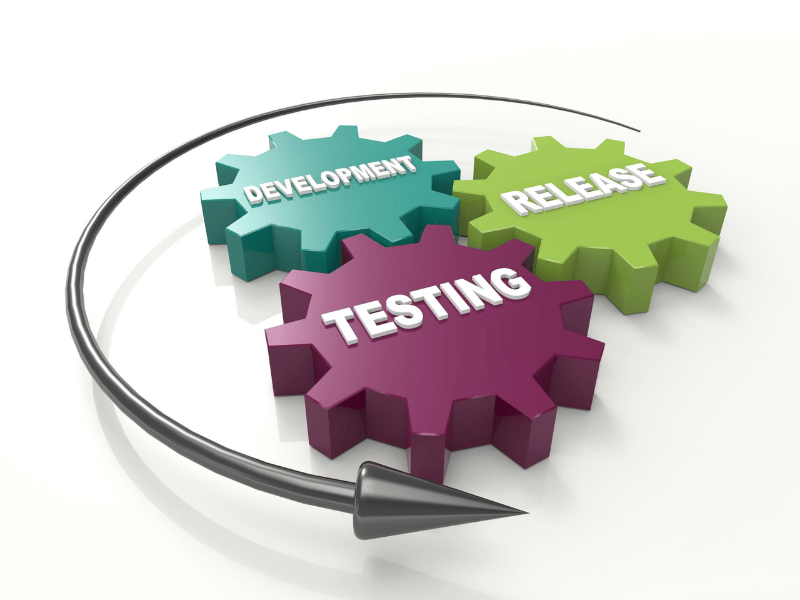
Release Cycle = Development + Validation + Approval + Deployment
Development is only one part of the equation. If validation consumes days while development takes hours, optimizing coding speed alone produces limited business impact. This is where AI QA starts changing the conversation.
What AI QA Actually Changes in the Software Lifecycle
From Slow Checklists to Continuous Quality Validation Signals
To scale automation responsibly without exposing the business to security flaws, corporate leaders must understand exactly what an AI QA layer changes within the software lifecycle. This technology does not mean granting autonomous release approval authority to an unsupervised model, nor does it mean removing human engineering architects from the governance path.
AI QA is often misunderstood. Some teams imagine fully autonomous testing platforms making release decisions without human oversight. Others assume it is simply traditional automation with a new label. In practice, AI QA sits somewhere in between. It acts as an intelligence layer that improves how validation work is created, prioritized, executed, and analyzed. Instead of relying entirely on manually designed test suites, AI-supported quality workflows can use multiple inputs:
- Product requirements
- User stories
- Source code changes
- Historical defects
- Existing regression libraries
- Runtime and production signals
From these inputs, the system can support activities such as:
- generating draft test scenarios,
- selecting high-risk regression paths,
- analyzing failures,
- identifying duplicated testing effort,
- and helping teams understand where validation effort should be focused.
This changes an important dynamic.
Traditional QA often asks:
“What should we test?”
AI QA increasingly asks:
“What should we test first?”
That shift matters because faster releases rarely come from running more tests. They come from running the right tests earlier.
Three Ways AI QA Helps Reduce Release Cycles
1. Faster Validation pass
One of the biggest sources of release delay is not test execution—it is test preparation.
Teams spend time:
- writing scenarios,
- maintaining scripts,
- updating environments,
- reviewing failed runs,
- and repeating manual validation.
AI reduces this preparation overhead. Instead of starting from a blank page, teams can generate initial test structures from requirements, existing repositories, or previous releases. This does not eliminate review. It changes where human effort is spent. Rather than writing repetitive scenarios manually, QA engineers can focus on improving coverage, validating business behavior, and identifying meaningful risks. This becomes especially valuable for organizations running frequent releases across multiple applications. The result is not fewer testers. It is more effective testing time.
2. Continuous CI/CD Testing Integration
In a traditional development model, testing functions as an isolated, final-stage gate that occurs after a build is compiled, creating long wait times and delayed feedback loops. AI QA restructures this sequence by embedding intelligent validation directly into your active CI/CD testing pipelines.
Code changes are systematically verified as they move through repository pull request stages, meaning that syntax errors, security flaws, and logic anomalies are isolated the moment a developer hits save. This continuous loop prevents broken code from migrating downstream, ensuring that your core staging branches remain in a permanently deployable state.
3. Risk Balancing and Deployment Confidence
Accelerating your time-to-market must never mean executing reckless deployments. To balance speed with strict software safety, the platform applies advanced risk scoring to every incoming pull request. The model evaluates recent code complexity, module defect histories, and test coverage metrics to calculate an objective deployment confidence score.
If a modification is classified as low-risk (such as a basic formatting fix or documentation update), the system routes it through automated validation gates for rapid deployment. If a code change touches a sensitive area (like identity authentication models or payment lines), the system automatically triggers an escalation path, preserving final human approval for high-risk corporate decisions.
A Practical Operating Model to Deploy AI QA Safely
Successful AI QA adoption usually starts smaller than most organizations expect. Trying to automate every workflow immediately often creates more complexity than value. A more practical rollout follows four stages.
Stage 1: Stabilize Core Regression Paths
Identify business-critical journeys.
Typical candidates include:
- login,
- account creation,
- payment,
- customer onboarding,
- core APIs.
These areas create the strongest return because they combine frequency and business impact.
Stage 2: Introduce Intelligent Prioritization
Connect machine learning utilities to rank and select test cases based on code change impact, module defect records, and historic failure patterns. This ensures your teams move away from a “test everything” mindset to run only the specific scripts required to secure the modified code environment.
Stage 3: Connect QA Into Delivery Pipelines
Testing should become invisible infrastructure. Developers should not manually move information between disconnected systems. Validation should happen automatically as part of normal delivery.
Stage 4: Create Learning Loops
Track outcomes. Understand where automation succeeds. Understand where human review still creates value. Continuous improvement matters more than automation coverage.
Measuring Whether AI QA Is Actually Working
Evaluating a modern quality transformation by monitoring superficial tool activity metrics—like the number of automated licenses activated or the volume of machine comments generated—creates a dangerous accounting illusion. High tool usage does not automatically mean your system efficiency has improved.
To satisfy financial oversight and verify actual returns, technology executives must align their dashboards with system outcomes and hard delivery performance metrics popularized by Google Cloud’s global DORA research program framework:
- Lead Time for Changes: Tracks how fast an idea travels from the initial commit to a live client frontend.
- Deployment Frequency: Measures whether your delivery pipelines can successfully release updates more often.
- Regression Cycle Duration: Quantifies the reduction in total hours spent waiting for validation passes.
- Developer Wait Time: Measures the velocity of your time-to-feedback loops after an engineer commits code.
- Defect Escape Rate: Tracks the percentage of bugs or logic flaws slipping past gates into live production.
- Change Failure Rate: Monitors the percentage of releases that cause immediate system degradation or rollbacks.
- Mean Time to Recovery (MTTR): Measures how fast your technical squads can isolate and fix live production outages.
Common Mistakes That Slow Releases When Scaling AI QA
Many organizations struggle with AI QA for reasons unrelated to technology. The tools work but the operating model does not. Several patterns appear repeatedly. The first is automating unstable workflows too early. If interfaces and requirements change constantly, generated tests quickly become maintenance work. The second is treating automation as a replacement for engineering judgment. AI can accelerate validation. It cannot fully understand business intent. The third is optimizing for quantity.
Generating thousands of tests does not guarantee stronger coverage. Coverage quality matters more than script volume. Finally, many teams leave QA disconnected from DevOps and release management. That separation limits most of the value. Release acceleration happens when validation becomes part of delivery—not an isolated department.
Regional Complexity: Scaling Release Velocity with AI QA Globally
For engineering teams serving clients across highly scrutinized markets, automated development tools cannot be treated as informal productivity shortcuts. They directly impact source code stability, intellectual property data custody, and legal auditability:
- The Swiss Market: Known for high-security, trust-reliant fields like private banking, wealth management, and medical technology, Switzerland enforces strict data custody and operational resilience standards under FINMA oversight. Software validation pipelines here must maintain absolute data lineage and clear code provenance tracking to ensure that automated testing configurations never introduce untraceable data-handling paths.
- The European Union: Operating within the European theater requires strict alignment with data protection codes and the phased enforcement milestones of the unifiedEU AI Act. Continuous quality gates must generate clear, auditable test evidence logs to satisfy mandatory compliance audits for high-risk systems.
- The United States & UK: Development units face immense pressure from corporate boards to align their data pipelines and secure software lifecycle with the NIST Secure Software Development Framework, demanding secure API validation and transparent threat modeling.
How IMT Solutions Can Support Your AI QA and Release Acceleration Initiatives
Achieving sustainable release acceleration through intelligent quality engineering is not a basic software tool deployment challenge. It is a comprehensive system lifecycle transformation that demands extensive expertise in test automation design, legacy application modernization, DevOps optimization, and global data governance.
IMT Solutions acts as a trusted digital transformation and software engineering partner, helping enterprises design, build, and optimize secure-by-design automation foundations under strict ISO 27001-certified security standards. Closely aligned with our core automation frameworks outlined in AI in DevOps, we can optimize your software lifecycle.
If your software delivery pipeline is acting as a major release bottleneck, or your teams are losing focus time manually running repetitive checklists, it is time to upgrade your framework. An independent engineering review can help your leadership team optimize DevOps workflows, improve automated testing coverage, mitigate technical debt, and establish real value verification before you scale spending further. Explore our latest integration approaches in Blogs – IMT Solutions, analyze our live delivery history in Case Studies – IMT Solutions, or connect with our platform specialists at Contact IMT Solutions to advance your software lifecycle with absolute confidence.
Conclusion
Organizations rarely struggle because developers write code too slowly. More often, they struggle because confidence arrives too late. AI QA changes that equation.
By improving validation speed, connecting testing into delivery pipelines, and helping teams focus on meaningful risks, organizations can shorten release cycles without sacrificing quality. But adoption alone is not transformation. Real value appears when automation, governance, and engineering discipline work together. Because in modern software delivery, moving faster is only useful if you can keep control while doing it.
FAQ
Can AI QA really reduce release cycles?
Yes. AI QA helps reduce manual testing effort, prioritize validation, and shorten feedback loops, which can reduce overall release time.
Does AI QA replace human QA teams?
No. Human teams remain responsible for business validation, release governance, and risk decisions.
What metrics matter most after adoption?
Lead time, deployment frequency, defect escape rate, regression duration, and MTTR are strong starting points.
Where should teams start?
Start with stable regression workflows and integrate validation gradually into existing delivery pipelines.
Is AI QA suitable for enterprise environments?
Yes—especially when combined with strong governance, CI/CD integration, and measurable delivery outcomes.