Autonomous QA:
The Future of AI-Powered
Software Testing
Your biggest release bottleneck may be QA — not engineering.
Many software teams are already using AI coding assistants, automated code review, test generation tools, and faster development workflows. Developers can write code faster, open pull requests faster, and move through early development tasks with less manual effort.
But faster coding does not automatically mean faster releases.
If testing still depends on long manual regression cycles, fragile scripts, and delayed validation queues, the release pipeline will slow down at the QA stage. This is where Autonomous QA becomes important.
Autonomous QA is not about replacing QA teams. It is about using AI-powered testing, automation, and continuous quality signals to help QA leaders release faster without losing control of software quality.
For QA leaders, CTOs, VP Engineering teams, and product delivery leaders, the message is simple: if development speed increases but testing cannot keep up, QA becomes the bottleneck. The future of testing is not manual QA versus automation. It is a smarter, hybrid quality model where AI handles repetitive work and humans focus on risk, strategy, and release confidence.
Why Manual Processes Stymie Progress and Mandate a Shift to Autonomous QA
Why Traditional Validation Fails Under Accelerated Code Generation
Layering high-speed development tools over legacy, manual testing pipelines inevitably pushes your software blockages downstream. Manual verification functions perfectly when release windows are slow and feature changes are small, but it breaks down completely when code influx doubles. To maintain a competitive market velocity without sacrificing software stability, technology leaders must automate repetitive regression checks and transition toward an intelligent quality engineering framework.
Manual QA still has value. Human testers understand user behavior, edge cases, business logic, and product intent in a way automation cannot fully replace.
The problem is scale.
Modern software teams release more often, work in shorter cycles, and handle more frequent changes across applications, APIs, cloud infrastructure, and user interfaces. When AI-assisted development increases the speed of code creation, QA teams face even more pressure.
Manual QA struggles when:
- Regression testing takes too long.
- Test cases are written manually for every sprint.
- QA teams repeat the same checks before each release.
- Test coverage is inconsistent across modules.
- Bugs are found too late in the release cycle.
- Automation scripts break when UI or API changes occur.
- QA work happens at the end of the pipeline instead of continuously.
The result is predictable. Developers move faster, but releases still wait for validation. Product teams expect speed, but QA teams are forced to choose between coverage and deadlines.
This is not a people problem. It is a workflow problem. Faster development does not create faster releases if testing cannot keep up.
What Is Autonomous QA?
Autonomous QA is an AI-assisted quality engineering approach where testing tasks such as test case generation, regression selection, test execution, failure analysis, and coverage prioritization are increasingly automated and integrated into the software delivery pipeline.
It does not mean:
- Removing QA engineers
- Eliminating human judgment
- Fully automating every release decision
- Trusting AI-generated test cases without review
- Replacing test strategy with tools
It means:
- AI helps generate test cases faster.
- Automation runs regression checks continuously.
- QA teams focus on high-risk areas.
- Test coverage becomes more intelligent.
- Failure signals are analyzed earlier.
- Release decisions become more data-driven.
In a traditional QA model, testing often happens as a final checkpoint before release. In an Autonomous QA model, quality checks happen continuously across the development lifecycle.
The QA team’s role also changes. Instead of spending most of their time repeating manual checks, QA leaders can focus on strategy, risk, exploratory testing, coverage quality, and release confidence.
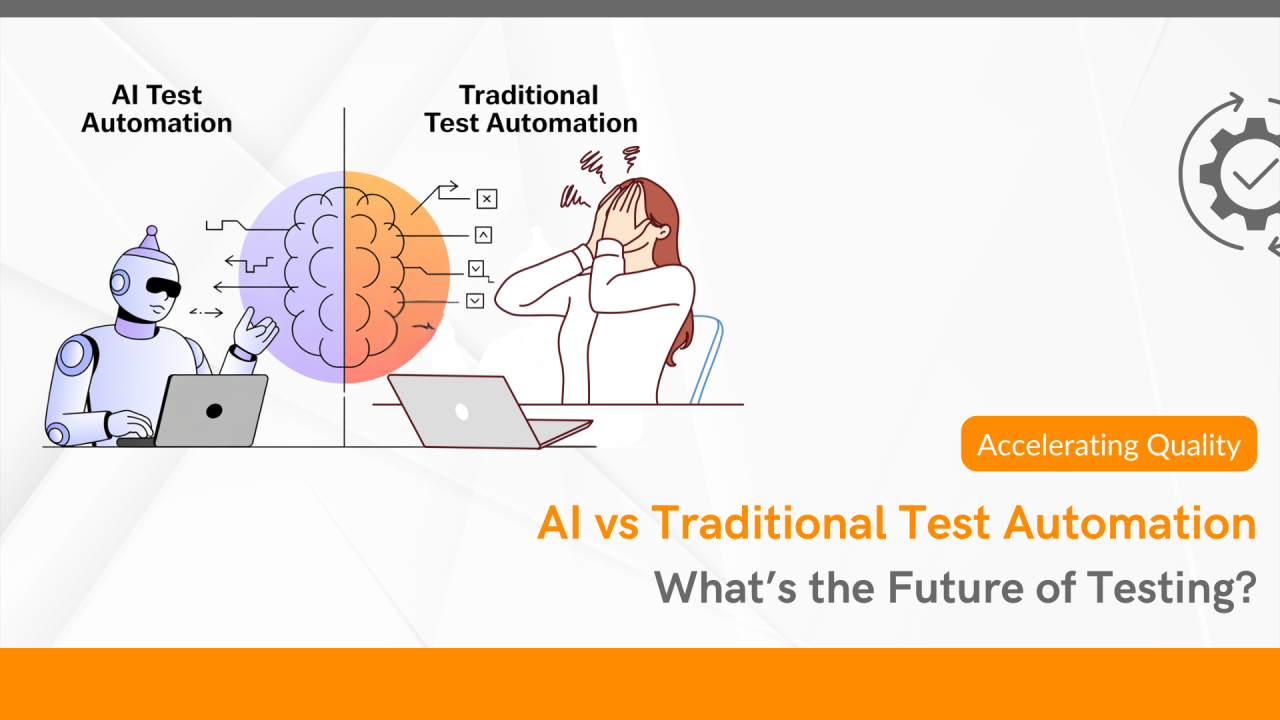
How Autonomous QA Is Different From Traditional Test Automation
Comparing Programmed Rule Enforcement with Adaptive Intelligence
Traditional testing scripts operate on rigid, pre-programmed rules that break down the moment a software layout changes. Conversely, autonomous testing frameworks leverage machine learning to analyze the intent behind a software interface, allowing scripts to self-heal and adapt dynamically during execution. Moving to an autonomous paradigm reduces your ongoing technical debt and dramatically shortens the lifecycle from feature design to live production verification.
Traditional test automation is valuable, but it is often rigid.
A traditional automated script follows fixed steps. It clicks a button, fills a field, checks a result, and fails when the UI or flow changes unexpectedly. This works well for stable workflows, but it creates maintenance pressure when products change quickly.
Autonomous QA adds intelligence to the process.
It can help generate test cases from requirements, prioritize regression tests based on risk, analyze failed test runs, suggest script updates, and identify coverage gaps. This does not remove the need for QA engineers, but it reduces the repetitive work that slows them down.
A simple comparison:
| Area | Traditional Test Automation |
Autonomous QA |
|---|---|---|
| Test creation | Manually scripted | AI-assisted generation from requirements, user stories, APIs, or logs |
| Regression testing | Fixed test suites | Risk-based and prioritized regression |
| Test maintenance | Manual script updates | AI-assisted update suggestions |
| Failure analysis | Manual log review | AI-assisted failure summaries |
| Coverage |
Based on planned scripts |
Continuously checked against requirements, code changes, and user journeys |
| Release support | Test execution report | Quality signals for release decisions |
Traditional automation helps teams run tests faster. Autonomous QA helps teams decide what to test, when to test, and where risk is increasing.
Five Strategic Operational Capabilities of Autonomous QA Systems
Leveraging Machine Intelligence Across the Software Lifecycle
Implementing a continuous AI-powered testing strategy allows technology teams to embed validation parameters into every stage of development. Rather than treating quality checkups as a final, high-pressure obstacle before deployment, an autonomous framework utilizes machine learning to continuously draft, execute, self-heal, and analyze test cases based on real-time code modifications, protecting system performance at scale.
AI-powered testing is most useful when QA teams need speed, coverage, and pattern detection.
AI Test Generation
AI can help draft test cases from user stories, acceptance criteria, product requirements, API specifications, bug reports, or existing test cases.
This is useful because QA teams often know what should be tested, but they do not always have enough time to write every scenario manually.
Recent quality engineering studies focused on generative end-to-end models like GenIA-E2ETest demonstrate that generative AI can successfully construct executable end-to-end test scripts from simple natural language descriptions, though human oversight remains essential to validate dynamic context paths.

Automated Regression Testing
Regression testing is one of the biggest QA bottlenecks.
As products grow, regression suites become larger and slower. Running every test before every release can waste time. Running too few tests can create release risk.
Autonomous QA can help by selecting and prioritizing tests based on recent code changes, affected modules, past defects, and risk areas. This helps teams focus on the tests that matter most for each release.
Test Coverage Analysis
AI can help compare requirements, code changes, user journeys, and existing tests to find missing coverage.
For example, if a new checkout flow is added but no test covers failed payment handling, the system can flag that gap earlier. If production logs show frequent use of a specific workflow, QA leaders can check whether that journey has enough automated coverage.
This helps QA teams move from “we have many tests” to “we are testing the right things.”
Defect Prediction and Risk-Based Testing
AI can support risk-based testing by analyzing signals such as:
- Recent code churn
- Historical defect patterns
- Complex modules
- Low-coverage areas
- Past incidents
- Customer complaints
- Frequently changed files
This helps QA leaders decide where human attention should go.
AI does not replace judgment, but it can help teams find risk faster.
Failure Analysis and Test Maintenance
When tests fail, QA engineers often spend time checking logs, screenshots, build history, and recent code changes. AI can help summarize possible causes, group similar failures, and identify repeated patterns.
AI can also help with test maintenance. When UI elements or API fields change, AI-assisted tools may suggest updates to broken test scripts. This reduces the maintenance burden that often makes automation expensive over time.
Where Human QA Still Matters
Autonomous QA should reduce repetitive testing, not remove human judgment.
Human QA teams are still essential for:
- Test strategy
- Risk assessment
- Critical user journeys
- Exploratory testing
- Business logic validation
- Usability and accessibility review
- Compliance-sensitive scenarios
- Edge cases
- Release sign-off
- Validating AI-generated tests
- Interpreting unclear failures
AI can generate a test case, but it may not understand why a workflow matters to the business. It can suggest a scenario, but it may not know whether that scenario is realistic. It can summarize a failure, but it may not understand the product impact.
According to data published in Capgemini’s World Quality Report 2025–26, roughly 43% of enterprise organizations are actively experimenting with generative AI within their quality engineering units, yet only a slim 15% have successfully scaled these initiatives enterprise-wide.
This massive execution gap reveals that technology alone cannot transform an organization; success requires a deliberate hybrid model that pairs autonomous execution speed with structured human management.
An Action Plan for Implementing a Hybrid Autonomous QA Workflow

The best model is not manual QA versus Autonomous QA. It is a hybrid testing model.
| QA Area | AI / Automation Role | Human QA Role |
|---|---|---|
| Test case generation | Draft cases from requirements | Validate relevance and priority |
| Regression testing | Run and prioritize test suites | Decide coverage strategy |
| Failure analysis | Summarize logs and patterns | Confirm root cause |
| Coverage analysis | Identify possible gaps | Define testing priorities |
| Edge cases | Suggest possible scenarios | Select business-critical cases |
| Compliance tests | Support documentation and traceability | Own approval and evidence |
| Release decision | Provide quality signals | Make final judgment |
In this model, AI improves speed and scale. Automation enforces repeatable checks. Human QA leaders focus on context, risk, strategy, and accountability.
This is how QA becomes a continuous quality layer instead of a final release gate.
How Autonomous QA Accelerates Releases
Autonomous QA can improve release speed in several practical ways.
First, it reduces test design time. AI can draft test cases from requirements, user stories, or acceptance criteria. QA teams then review and refine instead of starting from a blank page.
Second, it shortens regression cycles. Instead of running every test manually or running large suites without prioritization, teams can focus on the areas most affected by recent changes.
Third, it improves CI/CD quality gates. Testing becomes part of the delivery pipeline, not a separate process after development is complete.
Fourth, it detects defects earlier. By analyzing code changes, logs, and risk areas, Autonomous QA helps teams find issues before they reach staging or production.
Fifth, it improves release confidence. QA leaders get clearer signals about coverage, risk, defects, flaky tests, and regression status before release decisions are made.
Release acceleration should not mean skipping QA. It means making QA faster, more continuous, and better connected to engineering workflows.
A Practical Autonomous QA Workflow
A practical Autonomous QA rollout should start with the highest-value workflows, not every test in the organization.
Step 1: Map Critical User Journeys
Start with workflows that directly affect revenue, customer trust, or operational risk.
Examples include:
- Login
- Checkout
- Payment
- Account creation
- Data submission
- Core API flows
- Admin workflows
- Customer support workflows
These journeys should become the foundation of the QA strategy.
Step 2: Generate and Prioritize Test Cases
Use AI to draft test cases from requirements, but keep QA teams in control. Human QA engineers should review, edit, and prioritize the generated tests based on product risk.
Step 3: Automate Regression Suites
Focus first on stable, repetitive, high-value regression scenarios. Avoid automating unstable workflows too early, because that creates more maintenance work.
Step 4: Integrate Testing Into CI/CD
Testing should run as part of the pipeline. This helps teams detect issues earlier and prevents QA from becoming a final-stage bottleneck.
Step 5: Use AI to Analyze Failures
AI can summarize logs, group similar failures, identify repeated patterns, and suggest likely causes. This can reduce the time QA and engineering teams spend investigating failed runs.
Step 6: Keep Humans in the Loop for High-Risk Decisions
High-risk releases still need human review. QA leaders, product owners, engineering leads, and security teams should remain involved when changes affect critical workflows, sensitive data, or regulated processes.
Metrics QA Leaders Should Track
QA leaders should not measure Autonomous QA by test volume alone.
More tests do not automatically mean better quality. A large suite of weak or flaky tests can slow delivery and reduce trust.
Useful metrics include:
| Category | Metrics |
|---|---|
| Speed | Test creation time, regression cycle time |
| Coverage | Requirement coverage, journey coverage, code coverage |
| Quality | Defect escape rate, reopened bugs, production defects |
| Reliability | Flaky test rate, failed automation runs |
| Efficiency | Manual testing hours reduced, test maintenance effort |
| Release | QA-related release delays, release confidence |
| Governance | High-risk sign-off, audit evidence completeness |
The goal is not to prove that AI generated more tests. The goal is to prove that QA can support faster releases with better coverage, fewer escaped defects, and clearer release confidence.
Common Mistakes When Adopting Autonomous QA
1. Treating AI-Generated Tests as Final
AI-generated tests need human review. They may miss edge cases, misunderstand requirements, or create shallow scenarios.
2. Automating Unstable Workflows First
Start with stable and important workflows. Automating unstable areas too early creates maintenance debt.
3. Measuring Test Quantity Instead of Test Quality
A high number of tests can create false confidence if those tests do not cover meaningful risks.
4. Ignoring Flaky Tests
Flaky tests damage trust. If teams cannot trust the results, they will bypass or ignore automation.
5. Keeping QA at the End of the Pipeline
Autonomous QA works best when testing is integrated into CI/CD and involved earlier in development.
6. Removing Human Review Too Early
High-risk releases still need human judgment. AI can support decisions, but it should not own final sign-off.
How IMT Solutions Can Support Autonomous QA Transformation
Autonomous QA works best when it is connected to a mature engineering system. That system needs test strategy, automation design, CI/CD integration, DevOps discipline, secure development practices, and production monitoring.
IMT Solutions supports these areas through Independent Software Testing, DevOps Consulting, Product Development, Custom Application Development, Application Modernization, AI and Data, and Synthetic Monitoring.
For organizations where QA is slowing release cycles, an Autonomous QA readiness assessment can help identify the best path forward. This may include reviewing current testing workflows, automation coverage, regression bottlenecks, flaky test issues, CI/CD integration, and AI-assisted testing opportunities.
The goal is not to automate everything at once. The goal is to build a testing model that helps teams release faster with stronger confidence.
Explore related insights through Blogs – IMT Solutions, review practical delivery examples in Case Studies – IMT Solutions, or Contact IMT Solutions to discuss how to modernize your quality engineering workflow.
Final Thoughts: QA Is Becoming a Continuous Intelligence Layer
Autonomous QA is not about removing QA teams. It is about helping QA leaders scale quality as development speed increases.
AI test generation, automated regression, failure analysis, and intelligent coverage signals can help teams release faster. But human judgment remains essential for strategy, exploratory testing, business risk, and final release confidence.
The future of testing is not manual QA versus automation. It is a smarter quality workflow where AI accelerates repetitive work, automation enforces consistency, and QA leaders focus on the decisions that matter most.
Your biggest release bottleneck may be QA — not engineering. Autonomous QA is how teams start removing that bottleneck without sacrificing quality.
FAQ
What is Autonomous QA?
Autonomous QA is an AI-assisted approach to software testing where tasks such as test case generation, regression selection, execution, failure analysis, and coverage prioritization are increasingly automated and integrated into the delivery pipeline.
Does Autonomous QA replace human testers?
No. Autonomous QA does not replace human testers. It reduces repetitive testing work and helps QA teams focus on strategy, high-risk scenarios, exploratory testing, business logic, and release decisions.
How does AI test generation work?
AI test generation uses inputs such as requirements, user stories, acceptance criteria, API specifications, code changes, or logs to draft possible test cases or executable scripts. Human QA teams should still review and validate the results.
How does Autonomous QA speed up releases?
Autonomous QA speeds up releases by reducing manual test creation, automating regression testing, prioritizing high-risk areas, analyzing failures faster, and integrating quality checks into CI/CD pipelines.
What are the risks of AI-powered testing?
Risks include low-quality AI-generated tests, missed edge cases, hallucinated scenarios, flaky automation, poor CI/CD integration, and over-reliance on AI without human review.