Scaling AI Infrastructure: Data Quality, Storage & Retention Challenges
Storing logs for 10 years is mandatory – how do you do that without breaking the bank?
If you’re running high-risk AI in financial services, healthcare, or any regulated sector, that question is no longer theoretical. The EU AI Act’s automatic logging and technical documentation requirements are real and they generate data volumes that most enterprise infrastructure was never designed to handle.
The good news: organizations that design the architecture correctly from the start will keep costs manageable. The ones that bolt compliance onto an existing setup after deployment will pay far more – in storage bills, remediation effort, and regulatory risk.
This article can analyse compression, data versioning, and secure storage strategies that satisfy 10-year record-keeping rules, while avoiding ballooning costs. If you haven’t yet mapped your AI systems to their EU AI Act risk tier, our EU AI Act compliance guide is the right starting point before going further.
1. The Scale Problem: How Much Data Are We Actually Talking About?
High-risk AI systems generate far more data than most infrastructure teams plan for. Consider what automatic logging actually captures:
• Every inference event – input data, model version, output, confidence score, timestamp
• Every human override or escalation
• Every data ingestion and transformation event upstream
• Model retraining runs, evaluation metrics, version changes
• Operational events: latency, errors, fallback activations
For a mid-sized financial institution running an AI credit scoring system across tens of thousands of daily decisions, that adds up to hundreds of gigabytes per day. For a healthcare network processing AI-assisted medical imaging, the number is orders of magnitude larger – imaging files alone run in the gigabyte range per study.

The EU AI Act’s Article 12 requires high-risk AI systems to have “logging capabilities enabling automatic recording of events.” For certain systems – particularly those in law enforcement, border control, and infrastructure – logs must be retained for a minimum of six months. For healthcare and financial services AI, sector-specific regulations extend this significantly. Swiss banks subject to FINMA oversight, and healthcare providers under EU health data regulation, should plan for ten-year retention obligations across audit-critical records.
Most enterprise storage architectures weren’t designed for this. Most infrastructure budgets weren’t either.
2. Quality vs. Quantity: Hoarding Data Is Not a Strategy
There’s a tempting shortcut here: log everything, store everything, worry about organization later. That approach will cost you twice – once in storage, and once when an auditor asks you to locate a specific decision made two years ago and your logs are an undifferentiated mass of unstructured data.
The EU AI Act doesn’t just require you to store data. It requires you to demonstrate that your training data was representative, appropriately governed, and bias-audited. That is a quality requirement, not a volume requirement. What this means practically:
- Schema validation at ingestion, not after the fact. Garbage data stored for 10 years is 10 years of garbage – and it cannot be cleaned retroactively without breaking the audit trail.
- Metadata matters as much as the data itself. A training dataset without documented provenance, transformation history, and validation results is nearly useless for conformity assessment.
- Deduplication should happen early. Redundant event logs inflate storage without adding auditability. Deduplication at ingestion is far cheaper than deduplication at scale.
- Data that fails quality gates should be quarantined and flagged, not silently propagated into your archive.
For organizations that have been running AI on ad-hoc pipelines, the first compliance challenge often isn’t storage cost – it’s that they can’t clearly identify what data exists, where it came from, or whether it’s fit for purpose. We covered this data infrastructure gap in detail in our article on AI data infrastructure and compliance.
3. Storage Types: Hot, Warm, and Cold – and Storage Strategies
Not all compliance data needs to be instantly accessible. The most effective cost management strategy for long-term AI log retention is tiered storage – matching access frequency to storage cost.
Hot Storage (0–90 days)
NVMe SSDs, premium cloud tiers such as AWS S3 Standard or Azure Premium Blob. High performance, highest cost. Use for recent logs where fast retrieval supports active incident investigation and real-time monitoring. Model serving infrastructure and active decision logs live here.
Warm Storage (3 months – 2 years)
Standard SSDs, mid-tier object storage (S3 Standard-IA, Azure Cool Blob). Moderate cost, retrieval times in minutes. Use for data old enough that it won’t be accessed routinely but recent enough that regulatory investigations or customer disputes might require it on a reasonable timeline.
Cold Storage (2 years – 10 years)
HDD-based archives, cloud glacier tiers (AWS Glacier Deep Archive, Azure Archive, Google Coldline). Lowest cost, retrieval times measured in hours. This is where the bulk of your 10-year retention obligation lives. Data at this tier should be immutable, integrity-checked at regular intervals, and encrypted at rest. It will rarely be accessed – but when it is, it must be complete and verifiable.
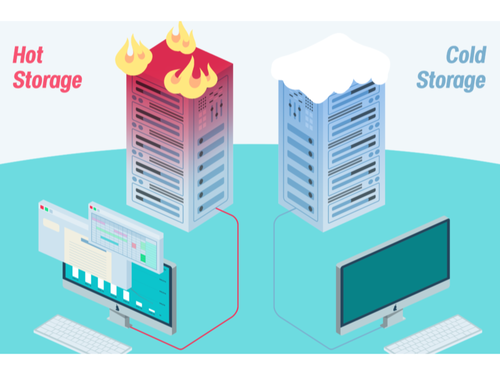
The cost differential is significant:
storing 1TB of data for ten years costs approximately $230 in hot storage, $130 in warm storage, and under $25 in cold storage on major cloud platforms For an enterprise managing 500TB of AI compliance data over a decade, the choice of storage tier is the difference between a $65,000 annual line item and a $1.15 million one. The tiering strategy is not a technical detail – it’s a financial decision.
4. Compression, Deduplication, and Formats That Don’t Age Badly
Tiered storage handles the access-frequency side of cost management. Compression and format selection handle the raw data volume side.
- Columnar formats with compression are the right default for structured log data – decision records, event logs, API calls. Apache Parquet with Snappy or Zstandard compression typically achieves 70–85% size reduction versus raw JSON or CSV, while remaining queryable without full decompression.
- Deduplication is most valuable for system state snapshots and metric logs, where the same values repeat across many records. Deduplication rates of 40–60% are common in this data type. Apply it at ingestion, not in the archive.
- Format longevity matters for 10-year archives. Data storage in a proprietary format dependent on specific software versions is a compliance risk as much as a technical risk. Open formats – Parquet, Avro, ORC, plain CSV – ensure readability regardless of infrastructure changes over a decade.
- Log data used for audit trail reconstruction should be compressed, not sampled. Sampling reduces storage but creates gaps in the audit chain that regulators will flag. If every decision must be traceable, every decision must be retained.
5. Retention Policies: The Conflicting Obligations Problem
This is where things get genuinely complex for most organizations: the EU AI Act requires long-term log retention; GDPR requires deletion of personal data when it’s no longer necessary or when a data subject requests it. Those obligations can conflict directly on the same data record.
EU AI Act (high-risk systems)
Automatic logs retained for a minimum of six months post-incident, or longer where sector-specific regulation applies. Technical documentation maintained for the entire operational lifetime of the system plus ten years.
GDPR
Personal data retained only as long as necessary for its original purpose. Retention of AI logs containing personal data beyond operational necessity requires a specific legal basis – usually regulatory compliance – and must be documented in your Records of Processing Activities (ROPA).
Financial services
Audit trails for AI-assisted financial decisions typically require 5–10 year retention under banking record-keeping obligations. Swiss banks under FINMA oversight should align AI audit trail retention with existing banking record obligations.
Healthcare
Clinical AI systems face retention obligations that parallel medical record requirements – in many jurisdictions, 10 years minimum, and up to lifetime of the patient for certain record types.
GDPR Deletion Workflows With Audit Trail Preservation
When a deletion request is honored, the deletion event itself – who requested it, when it was processed, what was removed – needs to be logged and retained. The audit trail of the deletion is itself a compliance record. You cannot simply delete the row and move on.
Note:
Retention policy needs to define, for each data category, the specific legal basis for retention, the minimum and maximum retention window, the deletion trigger and process, and the responsible data owner. This isn’t a one-size-fits-all schedule – it’s a data classification and governance exercise.
6. Infrastructure Design: Lakehouse Architecture for Compliance at Scale
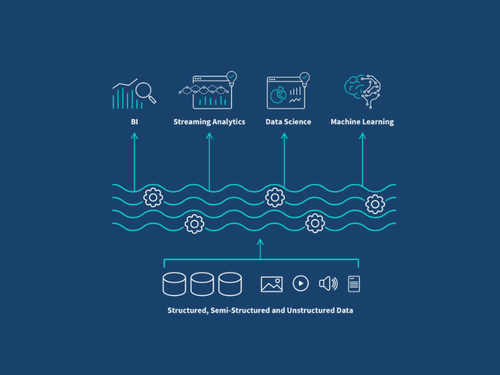
Lakehouse Architecture
The architecture that consistently handles compliance retention requirements at scale – without runaway costs – is the data lakehouse: a modern data management architecture that combines the low-cost, scalable storage of a data lake with the data management, reliability, and performance of a data warehouse. For AI compliance infrastructure, the pattern typically looks like this:
- Object storage as the foundation (AWS S3, Azure Blob, GCS, or on-premises MinIO for data residency constraints). Object storage scales horizontally without pre-provisioning, supports lifecycle policies that automatically move data between tiers based on age, and handles unstructured and structured data in a single system.
- A metadata and cataloging layer (Apache Iceberg, Delta Lake, or Apache Hudi) sits on top, providing ACID transaction support, schema evolution, and the ability to query historical snapshots – making 10-year archives auditable without full restoration.
- A lineage tracking layer (Apache Atlas, DataHub, or OpenLineage) traces every dataset from source through transformation to model training. This is the chain-of-custody requirement the EU AI Act places on training data.
- A compliance reporting layer assembles conformity documentation, audit trails, and post-market monitoring summaries from the layers below. For organizations running multiple high-risk AI systems, this layer needs automation – manually generating compliance reports for each system at each audit cycle is not sustainable.
Cloud vs. On-Premises: The Practical Trade-off
Cloud-native lakehouse architectures – Databricks, AWS Lake Formation, Azure Purview – offer the fastest deployment path and built-in compliance tooling. On-premises or hybrid architectures add complexity but satisfy data residency requirements that apply in Switzerland and Germany, where certain financial and health data must remain within national borders.
For most enterprises, the answer is a hybrid model: active data in cloud-native storage with residency controls, long-term archives on-premises or in a sovereign cloud region. The architecture decision should follow the data classification, not the other way around.
7. Case Study: How a Healthcare AI System Manages 10-Year Audit Logs Without Runaway Costs
A regional healthcare network operating across multiple hospitals and outpatient facilities in the EU deployed an AI-assisted radiology platform to support diagnosis of chest imaging conditions. The system processes thousands of imaging studies per week, generating substantial volumes of both imaging data and AI decision records.
The Compliance
Medical records retention in their jurisdiction runs 10 years minimum. The EU AI Act’s logging requirements apply to every AI-assisted decision – which imaging study was analyzed, which model version was active, what the output was, and whether a radiologist reviewed or overrode the recommendation. GDPR pseudonymization obligations required that personal data be separable from decision records on a per-patient basis.

The Architecture
- Imaging data (DICOM files): Stored in object storage with lifecycle policies moving studies to warm storage after 90 days and cold storage after 18 months. Lossless compression on metadata and clinically acceptable compression on archived imaging reduced the active storage footprint by approximately 40%.
- Decision logs: Model version, input metadata, output classification, timestamp, and radiologist review status – stored in Parquet format in a separate lakehouse partition. Pseudonymized at ingestion, with a separate encrypted identity resolution table retained for subject access requests. This partition is cold-stored from day one, indexed for audit queries.
- Model versioning and training data snapshots: Retained in a model registry with documented lineage – which data version, which training run, which evaluation results – satisfying the EU AI Act’s technical documentation requirement throughout the model lifecycle.
The Cost Outcome
Total storage cost for 18 months of operation – including imaging, decision logs, and model artifacts – came in approximately 35% below initial projections. The primary driver was tiered storage lifecycle automation combined with the compression strategy, which eliminated most of the storage footprint that would have accumulated in hot tiers by default.
The audit trail has already supported one regulatory inquiry – resolved in days rather than weeks, because the relevant decision records were queryable without manual reconstruction. That speed of response is itself a compliance posture: demonstrating that your infrastructure is ready, not just theoretically compliant.
8. Practical Steps to Start Today
If you have high-risk AI in production today, the logging and retention obligations are already in effect.
Audit What You’re Generating
Map every AI system’s log output by type, volume, and current retention period. Most organizations find they’re either retaining too much (all raw inference data indefinitely) or too little (deleting audit-critical records within 90 days).
Run a Storage Cost Model Before Designing the Archive
Most organizations significantly underestimate long-term AI log volume because they don’t account for model versioning, training data snapshots, and conformity documentation alongside decision logs. Build the cost model first, then design the tiering strategy around the actual projected volumes – not an abstract estimate.
Start the Pseudonymization Design Early
Retrofitting pseudonymization into an existing log stream is far more complex than building it into the pipeline from the start. The data entering your archive over the next 90 days is the data you’ll be managing for the next decade. The design decision you make now sets the cost and risk profile for the entire retention period.
Conclusion
The EU AI Act doesn’t just regulate what your AI does. It regulates how long you have to prove what it did. The technology to do this well exists and is mature. What most enterprises are missing is the architectural plan that maps legal obligations to infrastructure decisions – and the engineering discipline to implement it before the data accumulates in ways that are expensive to fix.
IMT Solutions helps enterprises build AI-ready data infrastructure that meets regulatory requirements across the EU and beyond – from architecture design through implementation and ongoing monitoring. Explore our blogs for the full AI compliance series, or reach out to talk through your infrastructure roadmap.
FAQ: AI Infrastructure Storage & Retention
How long does the EU AI Act require high-risk AI logs to be kept?
The EU AI Act requires logs generated by high-risk AI systems to be retained for a minimum of six months from deployment. However, sector-specific regulations – particularly in healthcare and financial services – frequently impose longer obligations. Healthcare records in many EU jurisdictions require 10-year retention, which effectively applies to AI-generated decision records associated with those records. Where sector rules and the AI Act overlap, apply the more restrictive requirement.
How do you handle GDPR deletion requests when the EU AI Act requires long-term log retention?
The standard approach is pseudonymization before archival. Decision records – model version, input parameters, output, timestamp – are retained without directly identifiable personal data. A separate encrypted identity resolution table allows subject access requests to be honored for the original data, while the audit log remains intact as a pseudonymized record. The deletion event itself must also be logged and retained as part of the compliance trail.
What is a data lakehouse and why is it useful for AI compliance?
A data lakehouse combines the scalability of object-storage-based data lakes with the query capability and transaction support of data warehouses. For AI compliance, the key advantage is that it makes large archives queryable for audit reconstruction without requiring full data restoration – enabling organizations to answer specific audit questions against petabyte-scale archives at manageable cost.
Is on-premises storage required for Swiss organizations, or can data be stored in the cloud?
Swiss organizations do not have a blanket on-premises requirement, but specific data residency obligations apply – particularly for patient data, certain financial records, and data subject to Swiss banking secrecy. Cloud storage is viable where data can be stored in Swiss or EU data centers with appropriate sovereignty controls. Most organizations in Switzerland run hybrid architectures: cloud-native for active data with residency controls, and on-premises or sovereign cloud for long-term archival.
What compression format works best for AI compliance log archives?
Apache Parquet with Snappy or Zstandard compression is the most widely adopted format for structured AI log archives. It achieves 70–85% size reduction versus raw JSON, remains queryable without full decompression, and is an open standard that will remain readable regardless of infrastructure changes over a 10-year retention period. For unstructured data such as medical imaging, format selection should be guided by clinical standards and the specific lossy/lossless trade-offs acceptable in your jurisdiction.